Friday, September 29, 2017

Puncture Repair

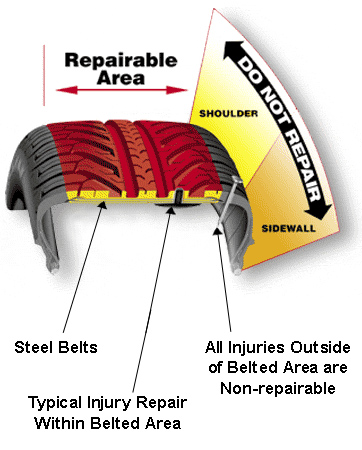
1. The puncture must be within the crown of the tire. (About 2-inches from each sidewall.)
2. The puncture must also be no larger than a pencil thickness. Approximately 3/16-inch or less.
3. If the sidewall has been compromised, (driven on with low pressure) the tire must be replaced.
4. Run Flat Tires can be repaired just like radial tires so long as the integrity of the tire hasn't been compromised. The tire must be removed to inspect for inside damage.


This picture shows the inside of a tire that has been compromised. Notice the bits of rubber compound. Also, you will see a 'Worm' style tire plug. These plugs are not recommended and are considered a temporary fix. In many cases these plugs will still leak air.
 
Here is the outside of the tire that faces the inside of the vehicle. The wear mark on the side wall indicates the tire has been driven on with low pressure, AKA Ran Flat.


This is the same tire. But this is the side facing outward on the vehicle. Most people only look at this part of the tire. As you can see, it looks to be in good condition. As we saw in the previous pictures, we know this tire has been compromised and is unsafe to drive on. This is why you must always inspect the whole tire, inside and outside.  


Here is a good example of a tire that is NOT repairable. The nail has punctured the shoulder of the tire. Punctures on the shoulder or sidewall can NOT be repaired. This tire will need to be replaced and can be claimed under "Road Hazard Warranty", if applicable. 
Sunday, August 20, 2017

Korean Service

한국어 서비스를 원하시는데 제가 자리를 비운 경우...
저에게 info@lynnwoodtires.com 으로 이메일을 보내주세요.

제가 자리를 비운 경우는 출장일 경우가 대부분이므로
빠른 답변을 드리기 어려울수도 있으니 미리 이해해주시기를 바랍니다.

이메일보다 카카오톡이 더 편하시면 카카오 아이디 JaeLim911 로 연락주시기 바랍니다.
감사합니다.


Tuesday, January 10, 2017

Run Flat Tire Pros & Cons


If you have modern BMW (or Mini Cooper, or Toyota Sienna, etc). you may have heard about Run Flat Tire (RFT). Basic idea is you can run when tire is flat (no air). Specifically, you can run about 50 mile at the speed of 50mph maximum (this differs by tire). That's the main advantage of RFT : when you have experienced puncture or damage to tire, you can still go to some (close) location.


Obviously vehicle manufacturers want that location to be their dealers, where you will spend money on these high priced tires. Yes, they are expensive, way more expensive than non-RFT. Let's look at the pros and cons about RFT in more detail:

Self Supporting RFT (Run Flat Tire)
Sidewall of conventional tires is very thin, yet it is the main part that supports the weight of the car (typically 3000 lbs or more). It cannot support weight of the car by itself without air. That is why air pressure is important. In RFT, side wall is reinforced (thick) to support the weight of the vehicle for short period of the time, in the event of air loss due to tire damage or puncture. This comes with big cost of price of RFT as well as compromised ride quality, due to stiffened side wall.

How expensive?
If you compare two identically sized tire prices (one RFT and one non-RFT) online...
http://www.tirerack.com/tires/TireSearchResults.jsp?width=225%2F&ratio=45&diameter=17&performance=ALL
Looking at the very common tire size, 225/45R17...
There are more than 160 tires to choose from (Non-RFT 130 & RFT 30). 
Non-RFT ranges from $70 ~ $200 per tire, and RFT ranges from $140 ~ $240.
As seen, RFT is way more expensive and also more expensive to install (mount and dismount).

Weight of the tire
RFT is typically heavier than non-RFT. Heavier tire means greater rolling resistance, which means more fuel to burn to turn that mass. 

Higher Rolling Resistance
Sidewall of the tire continuously changes its shape as it rotates, to ensure optimal traction against the road it touches. Stiffer sidewall requires greater force for it to shape, which also means higher rolling resistance.


Standard Tire


Run Flat Tire

Is it flat for not?
If you look at the non-RFT, it's quite easy to tell whether air pressure is too low, as bottom will look flat (hence "flat tire"). On the other hand, it's quite difficult to judge RFT's air pressure only by looking, as even RFT without much air still looks more round than non-RFT with no air. This is why TPMS (Tire Pressure Monitoring Sensor) is almost always required when manufacturer equips the car with RFT. TPMS can be convenient, yet it adds more cost to entire car and job.

Where is my spare?? 
Cars with RFT typically do not have spare tire. Instead, there's tire sealant, a bottle of chemical that you can inject through valve stem to temporarily seal the air leak. Even RFT with big leak can fail very quickly, so owner's manual states it is necessary to seal the tire with tire sealant and pump air to vehicle specification. Please note that this is temporary fix, just to get to the closest service station.


So what's good about RFT? You have more trunk space because there's no spare tire. You get that much weight reduction (but with added weight of RFT). Even when tire is completely flat, you can go somewhere. However, when you actually arrive at the tire shop or dealer, you will be likely surprised that RFT is not in stock, special order, and extremely expensive. Perhaps it's a good idea to buy non-RFT next time, save a lot of money and use that money for actual spare tire or AAA? It's up to owner's decision.

To be continued...

Monday, January 9, 2017

How To Find Tire Size

Before buying tires, the first thing you need to know is the tire size.

There are a few different ways to find the correct tire size for your vehicle. The first way is to check the side of the tire for a combination of letters/numbers. In the example below, you can see the tire size is 205/40R17.


The original tire size is also printed on a sticker (called "placard"), located inside the door jam, usually on the driver side (sometimes on the inside of gas cap). In the example below, the tire size is 225/45R18.

You can also check owner's manual for the correct tire size. 

If you have any question, you can always contact us at 425-243-7999 or info@lynnwoodtires.com.

Friday, December 23, 2016

내차의 타이어 사이즈는?

타이어 사이즈를 알아야 타이어의 재고 유무와 가격을 알수있습니다.

그래서 타이어를 구입하려면 우선 타이어 사이즈를 알아야 합니다.

타이어 사이즈는 Owner's Manual에도 나와있지만, 타이어 side wall에 양각으로 표시된 사이즈를 확인하는 것이 가장 빠릅니다 (아래 예의 사이즈는 205/40R17).


또는, 운전석을 열어 Door Jam에 붙어있는 Placard라는 스티커를 확인할수도 있습니다. 이 Placard에는 해당 차량의 타이어 규격과 공기압의 정보가 적혀있습니다. 다음 사진을 보면 타이어 사이즈는 앞뒤 모두 225/45R18 이며 공기압은 35PSI로 맞추라고 표시되어 있습니다.

(간혹 Volvo, Volkswagen, Audi 등의 차량에는 운전석쪽 Door Jam이 아닌, 주유구 커버에 이런 스티커가 붙어있는 경우도 있습니다)

이렇게 205/40R17 이나 225/45R18 같은 타이어의 사이즈를 알면 재고유무, 가격등의 정보를 훨씬 쉽고 빠르게 알아볼 수 있습니다.

Tuesday, November 3, 2015

겨울철 타이어 관리 - 역시 공기압이 가장 중요

화창했던 여름이 지나가고 이젠 제법 쌀쌀해졌습니다. 온도가 화씨 40도 (섭씨 4도) 이하로 떨어지면 본격적인 Winter Tire를 끼우는 계절이라 볼 수 있습니다. 혹시 사계절용/여름용 타이어외에 겨울용 타이어를 가지고 번갈아 끼워 타시는 분은 서둘러서 겨울용 타이어를 끼울 시기가 된것입니다.

사계절용 또는 여름용 휠/타이어 한세트와 겨울용 휠/타이어 한세트를 따로 준비해두고, 타이어 교환 (Mount & Balance) 없이 휠/타이어를 통채로 교환하시는 경우도 있는데, 비용과 공간이 허락한다면 이 방법이 가장 좋다고 할 수 있습니다 (휠은 그대로 쓰고, 타이어만 교환해가며 쓰는것도 나쁘지는 않습니다만, 매년 겨울과 봄에 Mount & Balance 비용이 발생하며, 그 비용을 3~4년간 쓴다면 아마 겨울용 휠/타이어 한세트를 구입하는 비용과 비슷할 것입니다). 이는 얼마나 오래 차를 소유할 것인지와, 자신의 주거공간 및 비용을 고려해서 결정할 부분이겠죠.

만일 겨울용 휠/타이어가 있다고 해도, 꼭 잊지 않아야 할것이 공기압입니다. 작년에 35 psi로 맞춰놓은 겨울용 휠/타이어를 그대로 끼우면 아마 공기압이 매우 낮아져 있을 것입니다. 타이어는 그냥 가만히 내버려둬도 한달에 약 1~2psi씩 공기가 빠져나간다고 합니다. 그래서 겨울전용 휠/타이어로 갈아끼우는 경우에도 공기압의 체크 및 보충은 필수입니다.

최근에 TPMS 경고등이 점등되었다는 전화문의도 많이 옵니다. 공기는 차가와지면 부피가 수축하므로, 공기압은 줄어들게 됩니다. 낮에 따뜻할때 35psi를 넣었는데, 아침에 다시 측정해보니 29psi 밖에 안되어 경고등이 들어오는것은, 1년중 이시기에 가장 많이 겪는 일중의 하나이며, 특히 Toyota 와 Lexus 차량이 더 민감하게 반응하는 것을 볼 수 있습니다. 전화로 약속을 잡으시고 오는길에 TPMS 경고등이 꺼졌다고 안오시는 분들도 있습니다. 낮에 온도가 올라가기도 했고, 고속도로에서 30분만 달려도 타이어는 따뜻해지기 때문에 다시 공기압이 상승하여 TPMS 경고등이 자동으로 꺼질 수 있는데, 이러한 경우 그냥 다닐것이 아니라, 평소보다 10% 정도 더 높은 공기압을 유지하기를 추천합니다 (가령 35psi를 넣어야 하는 차에 겨울철에는 38psi 정도를 넣어드립니다).

공기압이 낮았을때 가장 큰 문제는 타이어의 손상입니다. 실제 타이어의 Side wall은 두꺼운 종이정도로 얇고, 그 얇은 고무가 3000lbs에 육박하는 차의 무게를 지탱하는 것이 아니라, 그안의 공기가 지탱하는 것이기 때문에 공기압은 차의 관리에서 엔진오일만큼이나 중요하다고 하겠습니다. 낮은 공기압은 승차감면에서 조금 나을 수는 있으나, 타이어가 너무 눌려서 과열되는 현상을 일으키기도 합니다. 또 소음이 심해지고, 접지면적이 넓어져 조향감이 무뎌지기도 합니다.  공기압이 높으면 높을수록 타이어는 좀 딱딱해지기 때문에, 승차감을 나쁘게 하지만, 민첩한 조향감에 도움이 되며, 견딜수있는 최대적재량도 높아집니다.

공기압은 높게 넣고자 해도 타이어의 옆면에 각인되어 있는 최대허용치를 넘지 않아야 합니다 (일반 승용차 타이어의 최대 공기압은 약 44psi ~ 50psi 입니다). 일반적으로 짐을 많이 싣거나 항상 3~4명씩 동승운행하는 경우, 공기압을 조금 높게 유지하길 권장하며, 혼자서 가볍게 타고 다니는 경우 제조사에서 권장하는 공기압을 그대로 넣어 드립니다. 의사 선생님께서 저의 상태를 잘 모르는 상태에서 하루에 비타민알약을 한개씩 먹으라고 했다가, 점점 건강상태에 대해 깊이 알아가며 더 또는 덜먹으라고 할 수 있듯이, 타이어의 공기압도 주행습관, 도로상태, 기상변화, 차의 적재량에 따라 유연하게 조정하는 것이 필요합니다 (그리고 자신의 차의 공기압에 관심을 가지는 것이 필요합니다).